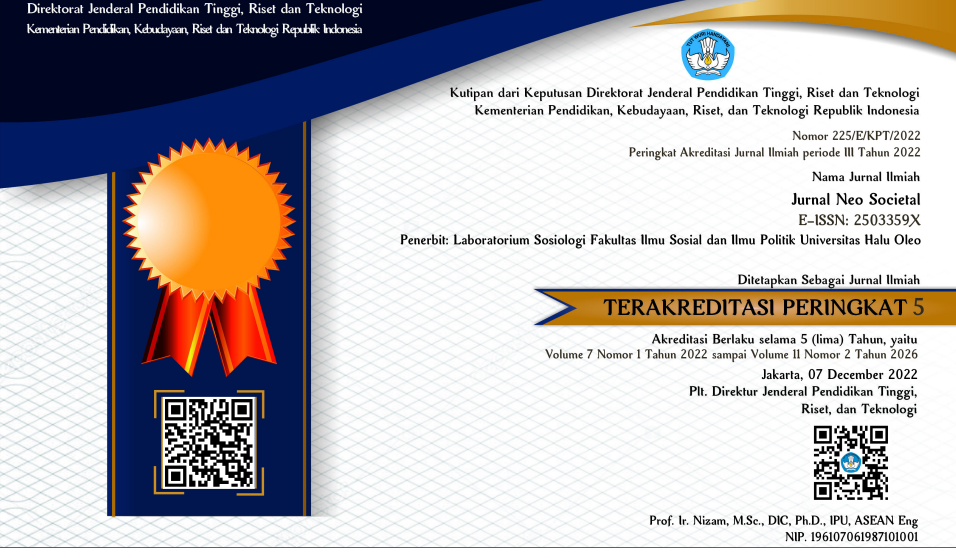
PERINGKAT SINTA
INFORMASI AUTHORS

Aim Of The Journal
JNS welcomes original research articles employing qualitative, quantitative, comparative, and mixed-methods approaches that make significant contributions to the development of sociology and the broader social sciences. The journal encourages critical and interdisciplinary scholarship that examines how religious values, communication practices, gender constructions and relations, processes of social transformation, welfare dynamics, and the formulation and implementation of social policies shape people's experiences, social relationships, and societal structures. In doing so, JNS serves as an academic platform for advancing theoretical perspectives, empirical findings, and policy recommendations that contribute to a deeper understanding of contemporary social challenges and promote the development of an inclusive, equitable, and prosperous society.
Journal Neo Societal (JNS) publishes original scholarly research that examines society and the dynamics of social life from sociological and interdisciplinary perspectives. The journal focuses on the relationships between individuals, social groups, institutions, power structures, cultural values, and processes of social change. It welcomes theoretical and empirical contributions that advance the understanding of contemporary social issues at local, national, and global levels.
JNS covers a broad range of topics, including but not limited to:
JNS welcomes qualitative, quantitative, comparative, and mixed-methods research, as well as theoretically informed and interdisciplinary studies that offer significant empirical findings, conceptual contributions, or policy implications. The journal particularly encourages research that critically examines emerging social issues, contributes to sociological debates, and provides insights into the development of inclusive, equitable, and sustainable societies.
Through its broad and integrative scope, JNS seeks to serve as an academic platform for researchers, scholars, and practitioners to advance sociological knowledge and promote a deeper understanding of contemporary societal transformations.