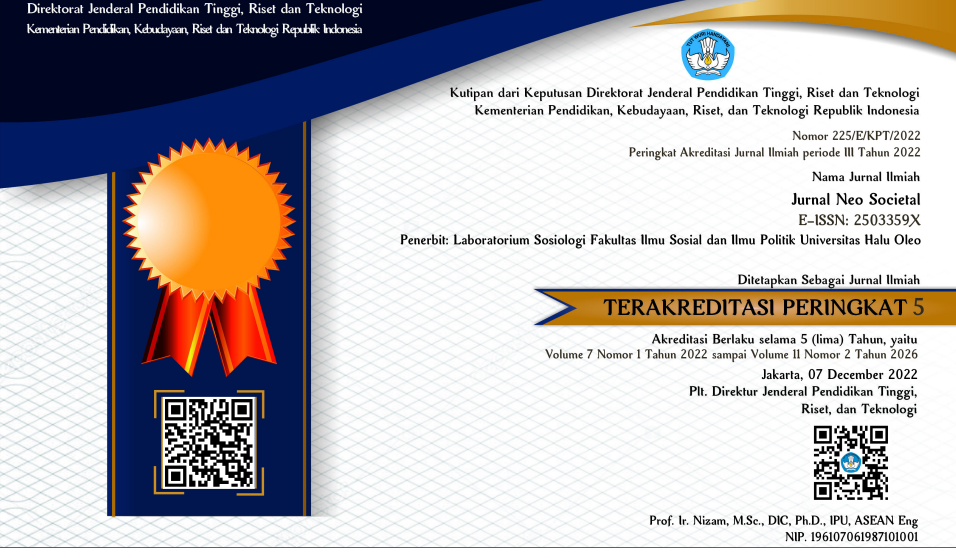
PERINGKAT SINTA
INFORMASI AUTHORS

Journal Neo Societal (JNS) is dedicated to preserving the credibility, transparency, and integrity of scholarly research and the published academic record. The journal does not accept research misconduct or unethical publication practices that may compromise the reliability of research findings or diminish trust in authors, reviewers, editors, and the broader scholarly community.
JNS addresses all allegations of research misconduct through objective, consistent, proportionate, and properly documented procedures. In examining such allegations, the journal may consult relevant principles and recommendations of the Committee on Publication Ethics (COPE). Where appropriate, JNS may also communicate with the academic institutions or research organizations affiliated with the individuals concerned.
This policy governs allegations of research and publication ethics violations relating to:
Allegations may be reported by authors, reviewers, editors, readers, research institutions, funding bodies, or other individuals and organizations possessing relevant information or a legitimate interest in the reported matter.
JNS may examine allegations concerning, but not limited to, the following practices:
These categories are not exhaustive. JSR may consider other suspected forms of misconduct according to the circumstances of the case, available evidence, and relevant standards of research and publication ethics.
Reports of suspected research misconduct may be submitted through JSR's designated official communication channel.
Where available, a report should provide:
Anonymous allegations may be examined when they contain sufficiently detailed, credible, and verifiable information. Nevertheless, anonymity may restrict the journal's ability to obtain clarification or undertake a comprehensive investigation.
Upon receiving an allegation, JNS conducts a preliminary evaluation to establish:
A preliminary assessment does not establish that misconduct has occurred. JNS will not attribute responsibility to an individual merely because an unverified allegation has been submitted.
Where an allegation requires further examination, JNS may review relevant materials, including:
For sociological research, relevant evidence may include interview transcripts, observation records, field notes, survey datasets, archival documents, and documentation of analytical procedures, subject to applicable confidentiality and research ethics requirements.
JNS may seek additional explanations or documentation from authors, reviewers, editors, research institutions, or other relevant parties.
Evidence will be assessed impartially and, where appropriate, through consideration of multiple sources rather than reliance on a single indicator or automated screening result.
Individuals accused of misconduct will, where circumstances permit, be afforded a reasonable opportunity to explain the reported issue, provide clarification, or submit supporting evidence before JSR implements a consequential editorial measure.
Explanations received will be evaluated alongside the available evidence and will not automatically establish either the validity or the dismissal of an allegation.
Where urgent intervention is required to safeguard the scholarly record, JNS may introduce temporary protective measures before the clarification process has concluded.
JNS acknowledges that universities, research institutions, or organizations responsible for conducting research may hold primary authority to investigate allegations concerning research misconduct.
When reported concerns involve research procedures, data fabrication, falsification, ethical approval, or other matters requiring institutional examination, JNS may request clarification or relevant documentation from the author or responsible institution.
Where justified and legally permissible, the journal may directly contact the institution concerned to communicate the allegation or request pertinent information.
Institutional referral does not relieve JSR of its responsibility to implement appropriate editorial measures when necessary to protect the reliability of the scholarly record.
When allegations concern an editor, reviewer, or editorial board member, individuals with relevant conflicts of interest must be excluded from the examination and decision-making process.
JNS may designate an independent editor or another appropriately authorized individual to manage the case.
Where allegations involve manipulation of peer review, undisclosed conflicts of interest, unauthorized disclosure of confidential information, or other unethical practices, JNS may take appropriate measures. These may include replacing a reviewer, excluding an individual from the ongoing editorial process, limiting future editorial involvement, or referring the matter to a relevant institution or competent authority.
Where plagiarism, duplicate publication, redundant publication, or unauthorized reuse of previously published material is suspected, JNS may examine the relevant publications and supporting sources and request clarification from the authors concerned.
If sufficient evidence substantiates the allegation, JNS may implement measures proportionate to the seriousness of the violation, including:
JNS regards allegations of fabricated, falsified, or manipulated research data as serious ethical concerns because such practices may undermine the validity of scholarly conclusions and the credibility of published research.
To assess these concerns, JNS may request:
In sociological research, this examination may concern the authenticity of interviews, observations, surveys, documentary evidence, statistical analyses, or qualitative interpretations.
Where substantial evidence suggests fabrication, falsification, or material manipulation, JNS may request a formal investigation by the author's institution and implement appropriate editorial measures concerning the submitted or published work.
For studies involving human participants, animals, personal information, or sensitive research materials, JNS may require documentation concerning ethical approval, informed consent, privacy safeguards, and other applicable research ethics obligations.
In sociological research, particular attention may be directed toward the protection of interview participants, research informants, vulnerable populations, and communities whose identities or experiences could be exposed through publication.
When allegations indicate that research proceeded without required ethical authorization or failed to provide adequate protection for participants or research subjects, JSR may request relevant explanations and supporting documentation.
In serious cases, the journal may refer the matter to an appropriate research institution, ethics committee, or competent authority and undertake editorial action consistent with the nature of the concern.
Failure to disclose a relevant conflict of interest may constitute an ethical concern when the undisclosed interest could substantially influence research conduct, interpretation of findings, peer-review evaluations, or editorial decisions.
JNS may request authors, reviewers, or editors to identify and explain relevant interests.
When an undisclosed conflict is established, the journal may require an amendment to the conflict-of-interest declaration or implement other editorial measures proportionate to the seriousness and consequences of the issue.
JNS will safeguard the confidentiality of cases involving suspected research misconduct to the extent reasonably possible.
Case-related information will be disclosed only to individuals or organizations with a legitimate need for access, including designated editors, relevant authors, reviewers, the publisher, research institutions, ethics committees, or authorized regulatory bodies.
Confidentiality may be limited where disclosure is necessary to fulfill legal requirements, conduct an appropriate investigation, protect the integrity of the scholarly record, or comply with legitimate ethical obligations.
JNS will not impose adverse consequences on individuals solely because they have reported suspected misconduct in good faith.
Individuals submitting allegations are expected to communicate relevant information honestly, responsibly, and objectively.
Deliberately false accusations, defamatory statements, intimidation, harassment, threats, or reports intended to disrupt legitimate editorial procedures may be addressed separately under the journal's applicable policies.
Where an allegation presents a potential risk to the editorial process or published scholarly record, JNS may introduce temporary measures, including:
The implementation of temporary measures does not, in itself, establish that research misconduct has occurred.
Following an appropriate assessment, JSR may determine that one or more of the following actions are warranted:
In determining an appropriate response, JSR considers the seriousness of the concern, the strength of available evidence, the potential consequences for the scholarly record, whether the conduct appears intentional or inadvertent, and whether the identified problem can be adequately corrected.
When suspected misconduct concerns an article already published by JNS, the journal prioritizes the preservation of an accurate and trustworthy scholarly record.
Depending on the available evidence and outcome of the assessment, JNS may issue:
Where reasonably feasible, these editorial actions will be communicated transparently and linked directly to the article concerned.
Individuals assigned to examine allegations of misconduct must maintain independence and impartiality throughout the process.
Where an editor has personal, professional, institutional, financial, or other relationships that could compromise objective judgment, responsibility for the case must be transferred to an independent editor or another authorized individual.
Decisions concerning alleged research misconduct must remain free from inappropriate pressure exerted by authors, reviewers, academic institutions, sponsors, or other parties lacking legitimate editorial authority.
JNS maintains appropriate records of cases involving suspected research misconduct, including:
These records are retained to support procedural consistency, editorial accountability, and the integrity of the journal's publication practices.
Where JNS lacks the authority or institutional capacity to establish facts requiring a formal investigation, particularly concerning research conduct or institutional procedures, the journal may refer the matter to the author's institution, research organization, ethics committee, publisher, or another appropriate authority.
JNS may await the findings of an institutional investigation when those findings are necessary to determine the appropriate editorial response.
Nevertheless, when the reliability of the scholarly record is at risk, JNS may undertake justified editorial action without waiting for the institutional investigation to conclude.
JNS applies editorial and ethical measures in proportion to the nature and seriousness of the reported misconduct.
Minor administrative irregularities or errors that do not compromise research validity or integrity will not automatically receive the same treatment as fabrication, falsification, serious plagiarism, manipulation of peer review, or other substantial ethical violations.
Where supported by available evidence, the journal will distinguish between unintentional mistakes, administrative noncompliance, substantive research errors, and deliberate or repeated misconduct.
All individuals involved in the examination of suspected research misconduct are entitled to fair and impartial treatment.
JNS will not interpret an unverified allegation as evidence that misconduct has occurred. Equally, the journal will not dismiss credible concerns solely because they involve an author, reviewer, editor, or another individual associated with JSR.
Editorial determinations will be guided by the available evidence, applicable journal policies, relevant publication ethics principles, and the responsibility to maintain the reliability of the scholarly record.
In evaluating and addressing allegations of research misconduct, JNS may consult relevant principles, recommendations, and procedural guidance developed by the Committee on Publication Ethics (COPE), together with applicable standards of research integrity and ethical scholarly publication.
Where appropriate, the journal may adopt relevant case-handling procedures to ensure that allegations are examined fairly, consistently, objectively, and in proportion to the seriousness of the reported concern.
24.1 Authors
Authors are expected to:
24.2 Editors
Editors are responsible for:
24.3 Reviewers
Reviewers are required to:
24.4 Journal Neo Societal (JNS)
JNS is responsible for:
Jurnal Neo Societal (JNS) is committed to addressing allegations of research misconduct through procedures that uphold fairness, independence, transparency, consistency, and proportionality. The journal does not regard an allegation as proof of wrongdoing without appropriate examination, nor will it disregard credible concerns supported by relevant information or evidence.
Where necessary, JNS may collaborate with academic institutions, research ethics committees, publishers, and other competent authorities to obtain information essential to the assessment and resolution of a case.
The central objectives of this policy are to uphold research integrity, ensure fair and accountable editorial procedures, and protect the accuracy, credibility, and reliability of the scholarly record, particularly within sociology and related social sciences.