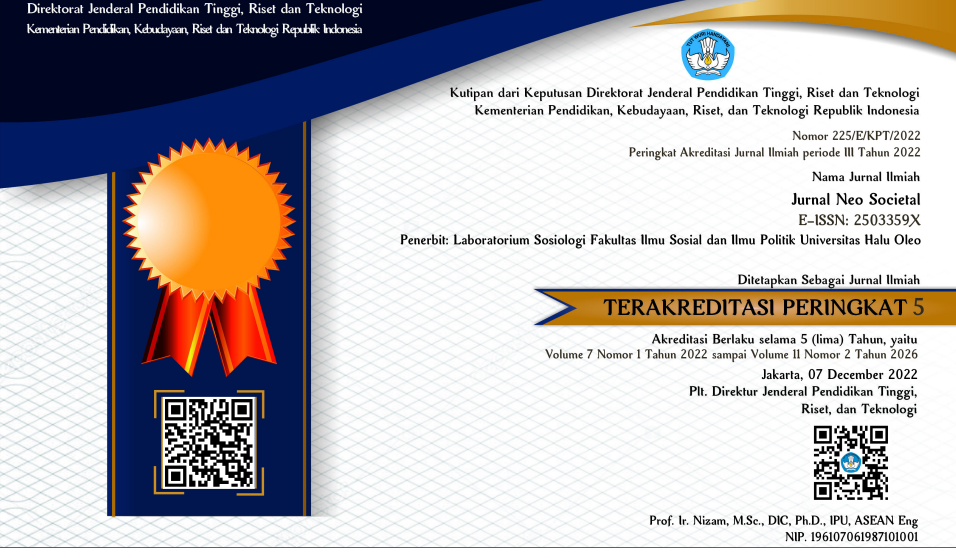
PERINGKAT SINTA

INFORMASI AUTHORS

Journal Neo Societal (JNS) acknowledges that conflicts of interest may occur when personal, professional, financial, institutional, academic, intellectual, or other interests have the potential to influence, or may reasonably appear to influence, the objectivity, independence, and integrity of scholarly research and editorial decisions.
This policy is established with reference to the relevant publication ethics principles and recommendations of the Committee on Publication Ethics (COPE). JSR upholds transparency, appropriate disclosure, impartiality, editorial autonomy, and responsible management of competing interests throughout the research and publication process.
JNS is committed to ensuring that manuscript submission, peer review, editorial evaluation, and publication are conducted fairly, independently, and with academic integrity. Accordingly, all individuals participating in these activities are expected to identify and disclose relevant competing interests and cooperate in implementing appropriate measures to address them.
When an actual, potential, or perceived conflict of interest is identified, JNS will evaluate the circumstances and determine an appropriate response in accordance with this policy and, where applicable, relevant COPE publication ethics guidance and procedures.
A conflict of interest arises when an individual's financial, personal, professional, institutional, academic, intellectual, or other interests could affect, or could reasonably be perceived as affecting, their professional judgment, actions, interpretations, or decisions concerning a manuscript or scholarly publication.
The presence of a conflict of interest does not automatically indicate unethical conduct or wrongdoing. Nevertheless, conflicts that remain undisclosed or are not appropriately managed may threaten, or create the appearance of threatening, the fairness and credibility of the research and publication process.
Conflicts of interest may be classified as:
Consistent with COPE's publication ethics principles, JNS considers transparent disclosure and responsible management essential to identifying and addressing competing interests.
This policy applies to individuals involved at any stage of JNS's editorial and publication activities, including manuscript submission, evaluation, revision, acceptance, production, and publication.
The individuals covered include:
All relevant individuals must disclose interests that could affect, or reasonably appear to affect, the independent performance of their responsibilities concerning a manuscript.
JSR expects competing interests to be managed in accordance with the principles of transparency, impartiality, and editorial integrity reflected in COPE guidance.
Conflicts of interest may arise from various circumstances and are not restricted to financial relationships.
Relevant categories include, but are not limited to, the following.
Financial Interests
Financial conflicts may involve:
Personal or Professional Relationships
Competing interests may arise from interpersonal or professional connections, such as:
Institutional Conflicts
Institutional conflicts may occur when an individual's university, department, research center, research group, or affiliated organization has a particular interest in the outcome of a study or publication.
Examples include:
Academic or Intellectual Conflicts
Academic or intellectual conflicts may emerge when an individual holds a strong professional or personal commitment to a particular theory, methodological approach, research dataset, scholarly interpretation, or competing research outcome.
Examples include:
In sociology and related social sciences, such conflicts may also involve competing theoretical interpretations, methodological commitments, or academic positions concerning particular social phenomena.
JNS recognizes that competing interests may not always be obvious or financial. In keeping with COPE principles, individuals should consider whether a reasonable author, reader, reviewer, or other stakeholder might perceive that a particular relationship or interest could influence scholarly judgment.
All authors submitting manuscripts to JSR are responsible for identifying and declaring relevant conflicts of interest.
Authors must disclose financial, personal, professional, institutional, academic, intellectual, or other relationships that could reasonably be perceived as affecting the conduct of their research, interpretation of evidence, preparation of the manuscript, or publication process.
Authors are required to:
These requirements reflect the principles of openness and responsible disclosure promoted by COPE.
Failure to declare a relevant conflict may constitute a breach of JNS's publication ethics policies and may lead to appropriate editorial measures.
Every manuscript submitted to JNS must contain a Conflict of Interest Disclosure Statement.
Authors must clearly indicate whether any relevant competing interests exist.
When no conflicts of interest are present, authors may use the following declaration:
Conflict of Interest: The authors declare that they have no conflicts of interest that could have influenced the research, analysis, interpretation, or publication of this manuscript.
Where relevant conflicts exist, authors should identify their nature with sufficient clarity. For example:
Conflict of Interest: Author 1 received research funding from [organization]. Author 2 provides consultancy services to [organization], which has a potential interest in the subject of this study.
Disclosures should provide meaningful transparency without unnecessarily revealing confidential personal information.
JNS may request further clarification or supporting information when the submitted statement does not adequately explain the potential significance of a competing interest.
Authors must report all relevant research funding and material support accurately and separately from their conflict-of-interest declarations.
Disclosures must identify support provided for:
Funding statements should specify the supporting institution or organization and, where applicable, the associated grant number or project identifier.
Authors should also explain whether the funding body participated in:
Receiving financial support does not automatically constitute a conflict of interest. Nevertheless, relevant relationships between funding organizations and the research must be disclosed transparently.
Consistent with COPE publication ethics guidance, JSR seeks to ensure that readers have sufficient information to understand the role of funding and material support in the production and publication of scholarly research.
JNS editors are required to safeguard editorial independence and base their decisions on the scholarly merit, originality, relevance, methodological rigor, and ethical integrity of submitted manuscripts.
Editors must not manage manuscripts when actual, potential, or reasonably perceived conflicts of interest could compromise their impartiality.
Such circumstances may include manuscripts:
Where a relevant conflict exists, responsibility for the manuscript should be transferred to an appropriately independent editor.
Editors must inform the editorial leadership of relevant competing interests and withdraw from decision-making when their independence could reasonably be questioned.
Confidential information obtained through editorial responsibilities must never be exploited for personal, professional, financial, or competitive advantage.
These obligations are consistent with COPE principles concerning editorial independence, confidentiality, accountability, and conflicts of interest.
Peer reviewers must disclose relationships or circumstances that could affect, or reasonably appear to affect, their independence in assessing a manuscript.
Reviewers should decline review invitations when they:
Reviewers are prohibited from using information obtained through peer review for personal, professional, financial, or competitive benefit.
They must also protect manuscript confidentiality and comply with JNS's peer-review and publication ethics requirements.
These responsibilities are consistent with COPE guidance concerning peer-review integrity, impartiality, confidentiality, and disclosure of competing interests.
JNS is committed to protecting editorial decisions from inappropriate commercial, financial, institutional, political, personal, or other external influences.
Editorial assessments and decisions must primarily consider:
In the context of JSR, these considerations include the relevance and contribution of research to sociology and related social sciences.
Authors, reviewers, editors, sponsors, institutions, and external organizations must not exert improper influence over editorial decisions.
Financial support for research or journal operations must not determine whether a manuscript is accepted, rejected, revised, or published.
JNS regards editorial independence as a fundamental requirement of responsible academic publishing and follows relevant COPE principles concerning editorial autonomy and competing interests.
Declaring a conflict of interest does not automatically justify manuscript rejection, removal of an individual from editorial activities, or a conclusion that misconduct has occurred.
JNS evaluates declared competing interests individually and determines appropriate measures to prevent or minimize their potential influence.
Such measures may include:
In determining the appropriate response, the editorial team may consider the conflict's nature, relevance, extent, timing, and possible consequences.
When a conflict raises substantial publication ethics concerns, JNS may consult relevant COPE flowcharts, guidance documents, or other applicable procedures.
When JNS identifies a possible conflict of interest that has not been disclosed or has been inaccurately reported, the editorial team may request clarification and supporting documentation from the individual concerned.
Depending on the circumstances, JNS may:
Where evidence indicates deliberate concealment or misrepresentation of competing interests, JNS may treat the matter as a potential breach of publication ethics or research integrity.
In examining such concerns, the journal may consult COPE guidance and editorial flowcharts and obtain relevant information from authors, reviewers, editors, research institutions, or other responsible organizations.
Where necessary, manuscript processing may be temporarily suspended until the concern has been appropriately evaluated.
Authors, editors, and reviewers must inform JNS whenever relevant competing interests emerge or change during the publication process.
Authors are required to update their declarations if circumstances change between manuscript submission and publication.
Likewise, editors and reviewers must promptly inform the editorial office when a previously unidentified conflict becomes apparent after they have accepted responsibility for a manuscript.
The journal may reconsider the editorial handling of a submission when new or previously undisclosed competing interests are identified.
Such reconsideration will follow this policy and, where relevant, applicable COPE publication ethics principles and recommendations.
JNS will examine conflicts of interest identified after publication according to their nature, seriousness, and possible implications for the published research.
Where an undisclosed relevant conflict is established, the journal may issue an appropriate correction, clarification, editorial notice, or other post-publication measure.
An undisclosed conflict does not automatically invalidate the findings of a published study. Nevertheless, further examination may be necessary when the conflict raises substantive questions about the research's integrity, interpretation, or reliability.
Where appropriate, JNS may request information from the authors' institutions or other responsible organizations.
In determining suitable post-publication measures, the journal may consult COPE guidance and flowcharts concerning corrections, Expressions of Concern, retractions, and related publication ethics matters.
JNS handles information regarding competing interests responsibly, and it primarily to identify, evaluate, and manage potential conflicts.
The journal distinguishes between disclosures necessary for public transparency and information that must remain confidential because of legitimate privacy, legal, or ethical considerations.
Where appropriate, relevant conflict-of-interest declarations may be published alongside the article to provide readers with sufficient contextual information.
Confidential information will be managed in accordance with JNS's editorial and peer-review confidentiality policies and relevant COPE principles concerning responsible editorial practice.
JNS considers the transparent identification and disclosure of competing interests an essential element of responsible research and scholarly publication.
Authors, editors, reviewers, and other individuals participating in publication activities must not conceal relevant interests that could influence, or reasonably appear to influence, their professional judgment.
Appropriate disclosure enables the journal and its readers to evaluate scholarly research and editorial procedures with a clearer understanding of potentially relevant circumstances.
Accordingly, disclosure serves as a mechanism for transparency and responsible management rather than automatically indicating unethical conduct.
JNS applies this approach in accordance with the broader publication ethics principles promoted by COPE, particularly transparency, accountability, editorial independence, and protection of the integrity of the scholarly record.
Journal Neo Societal (JNS) requires authors, editors, reviewers, and other participants in its publication activities to declare relevant competing interests that could influence, or reasonably appear to influence, their professional responsibilities, judgments, or decisions.
JNS acknowledges that conflicts of interest may arise from financial, personal, professional, institutional, academic, intellectual, or other relationships relevant to scholarly publication.
The existence of a competing interest does not automatically constitute misconduct. Nevertheless, failure to disclose relevant interests, deliberate concealment, or inaccurate reporting may compromise the credibility and integrity of scholarly research and may result in appropriate editorial measures.
JNS identifies, evaluates, and manages conflicts of interest in accordance with this policy and relevant ethical principles and guidance developed by the Committee on Publication Ethics (COPE).
Where competing interests give rise to broader publication ethics concerns, the journal may apply relevant COPE guidance, flowcharts, and procedural recommendations, as appropriate to the circumstances.
Through this policy, JNS seeks to uphold transparency, editorial independence, impartiality, accountability, responsible disclosure, and research integrity throughout the research and publication process, particularly in sociology and related social sciences, including studies of social structures, institutions, inequality, cultural practices, religious life, identity, social relations, and social transformation.
JNS recognizes COPE as an important reference framework for responsible scholarly publishing and will consider applicable COPE recommendations when addressing complex, unresolved, or potentially serious conflicts of interest and related editorial concerns.